

A Tuscan hill town, Siena once rivaled Florence in wealth and influence. The city is renowned for its stunning medieval core, home to some of Italy’s most marvelous Gothic monuments.
Nestled among three hills of Tuscany, Siena boasts a rich history dating back to Etruscan civilization. Local legend has it that the town was founded by the two sons of Remus, who fled from Rome after their father was murdered by his twin, Romulus. The brothers also carried a statue of the she-wolf suckling the infants with them, which has since become a symbol as iconic in Siena as it is in Rome.
Siena only grew into a thriving city-state by the 12th century, as it began to be involved in the wool industry and later expanded into commerce and banking. Notably, the world’s oldest bank, Banca Monte dei Paschi di Siena, was established in Siena, solidifying its status as a major banking center by the 13th and 14th centuries. However, this prosperity led to conflicts with Siena’s rival, Florence, particularly the Medici family, who later seized control of the city and prohibited its residents from conducting banking activities, thus hampering Siena’s economic power. The devastating blow came with the Black Death in 1348, wiping out two-thirds of the town’s population and leading to the downfall of a once prosperous and vibrant city.
It was a blessing in disguise as Siena’s centuries-long economic decline unexpectedly preserved its historic center, sparing it from extensive redevelopment and new construction. Its urban layout was left intact, with spiritual and civic monuments retaining their original Gothic appearance and remarkable art collections. All these make Siena an outstanding example of a medieval Tuscan city, resulting in its designation as a World Heritage Site in 1995.
An outstanding example of a medieval Tuscan city.


1. Piazza del Campo
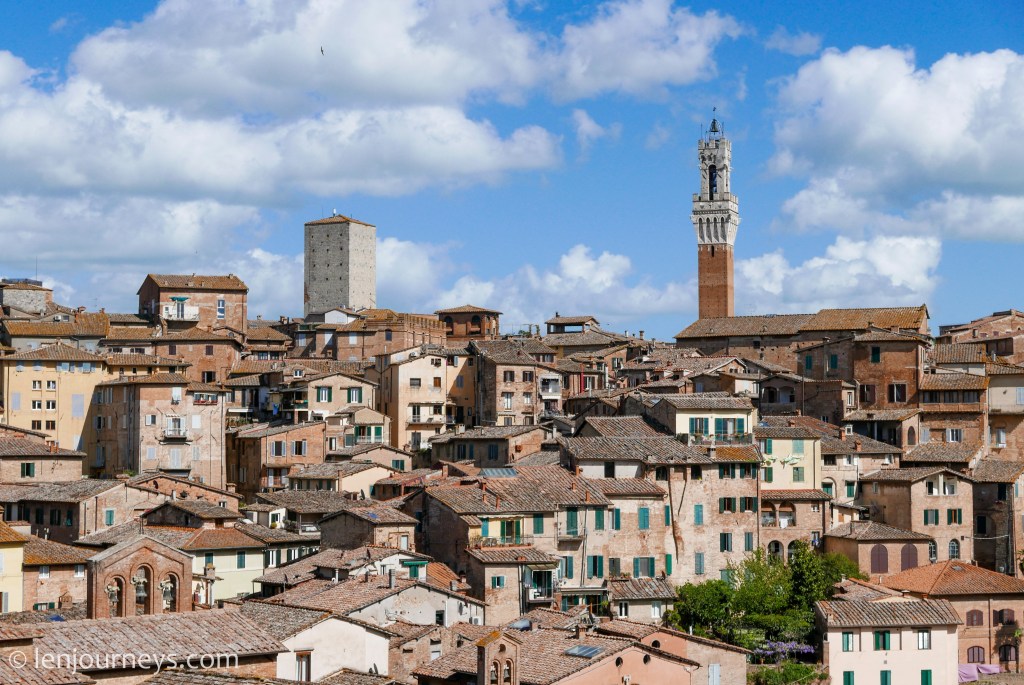
Passing through Porta Camollia, an ornate gate that made up the former defensive wall, I was magically transported to the medieval days. A picturesque town with centuries-old brick structures unfolded before me, with the magnificent Siena Cathedral reigning over it. The city is perched on three hills, connected by steep cobblestoned roads that serve as the town’s main thoroughfares. These arteries converge at a valley that became Piazza del Campo, the heart of Siena’s civic and social life since the mid-12th century.
The heart of Siena’s civic and social life.
This sloping plaza, built on the site of a Roman marketplace, features a unique shell-shaped layout divided into nine sectors, representing the number of governors in the former ruling council. Meanwhile, the smooth brick pavement, resembling a vast carpet, provides an ideal space for picnics and relaxation. The piazza is also the scene of the Il Palio, Italy’s most thrilling horse race, held annually during the summer.
On the south side of the square, the Palazzo Pubblico stands as a prime example of civil Gothic architecture. It was built between 1297 and 1310 and has served as the seat of Siena’s city council ever since. Its most remarkable feature is the elegant Torre del Mangia, which, on completion, was the tallest secular tower in medieval Italy. The structure was designed to be the same height (102m) as the cathedral, symbolizing the balance of power between the state and the church. Beyond its function as a residence for governors and magistrates, Palazzo Pubblico houses an extensive collection of the finest Sienese art.



2. Siena Cathedral
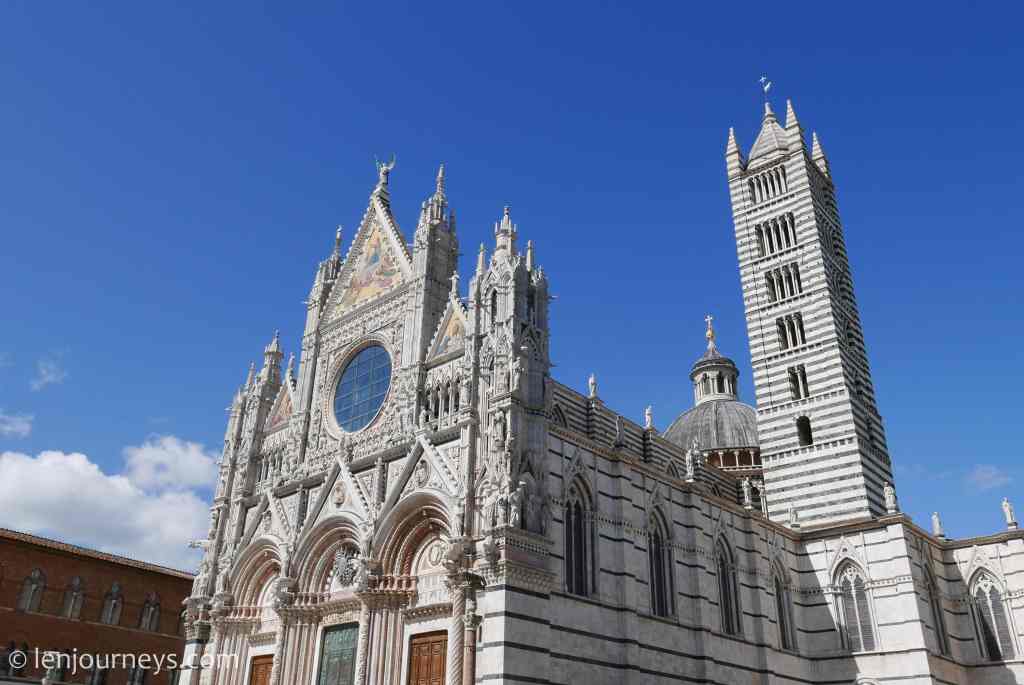
Rising majestically above the historic town, Siena Cathedral is easily one of Italy’s most awe-inspiring churches. The construction began in 1215 on the grounds of a 9th-century church dedicated to the Virgin Mary. Yet its final details weren’t completed until two centuries later, with contributions from many renowned Italian artists, including Nicola and Giovanni Pisano, Lorenzo Ghiberti, and Bernini. A massive expansion, intended to double the size of the Gothic cathedral, was underway in the 14th century. Unfortunately, this endeavor came to a sudden halt due to the Black Death, and the work has since never resumed.
A testament to Siena’s cultural zenith.
These days, Siena Cathedral, with its classic Latin-cross layout, grand dome, and candy-stripped bell tower, stands as a testament to the town’s cultural zenith. Its distinctive facade, crafted from white and greenish-black polychrome marble in alternating horizontal bands, creates a striking contrast against the surrounding brick structures. The addition of reddish marble on the main portal entrance, adorned with intricate statues of prophets, philosophers, and apostles, further enhances the cathedral’s captivating beauty.
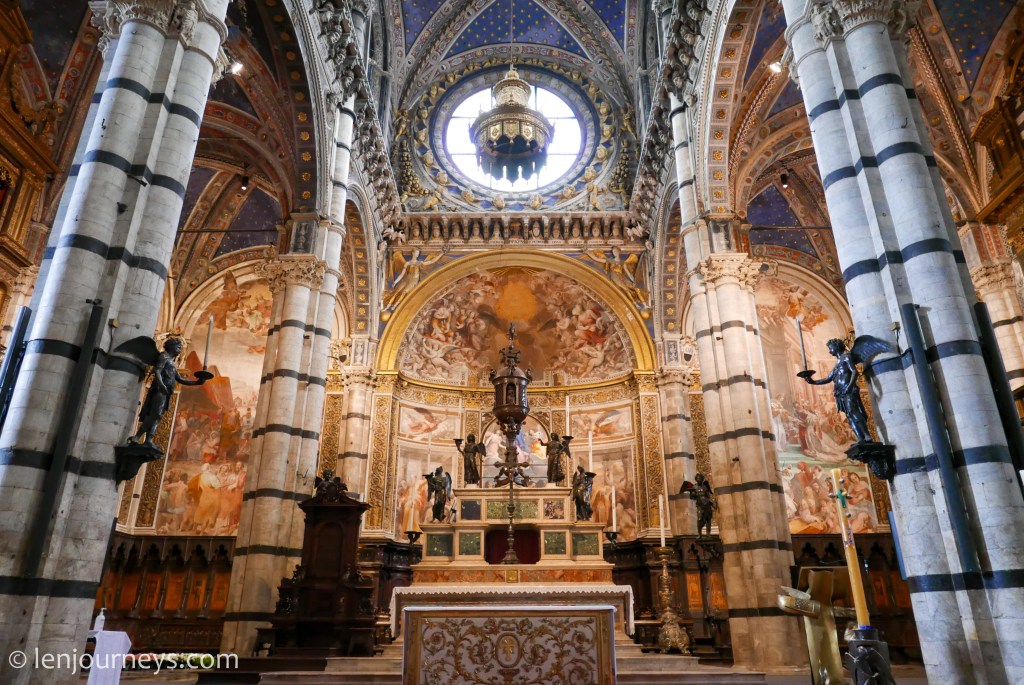
The interior of Siena Cathedral is equally fascinating, featuring an exquisitely carved pulpit, a gilded dome ceiling, and black-and-white striping throughout. Other ornaments, including frescoes, sculptures, and stained-glass windows, are masterpieces by medieval and Renaissance artists. Yet the cathedral’s most impressive feature is the 56 marble mosaic inlays and graffito panels on the floor. This centuries-long project, unveiled only a few weeks each year, reflects exceptional craftsmanship and the cultural heritage of Siena.



3. Picolomini Library
Still enchanted by the interior of Siena Cathedral, I eagerly queued up to enter the adjoining Piccolomini Library. Constructed around 1492, the library was a tribute from the archbishop of Siena to his maternal uncle, Aeneas Silvius Piccolomini, also known as Pope Pius II. This humanist pope, hailing from Pienza, had amassed a collection of rare books and manuscripts during his time in Rome. Hence, in homage to his uncle’s legacy, the archbishop erected a library on the site of a former clergy house. Interestingly, the archbishop himself later ascended to the papacy as Pope Pius III. Divine guidance, perhaps?
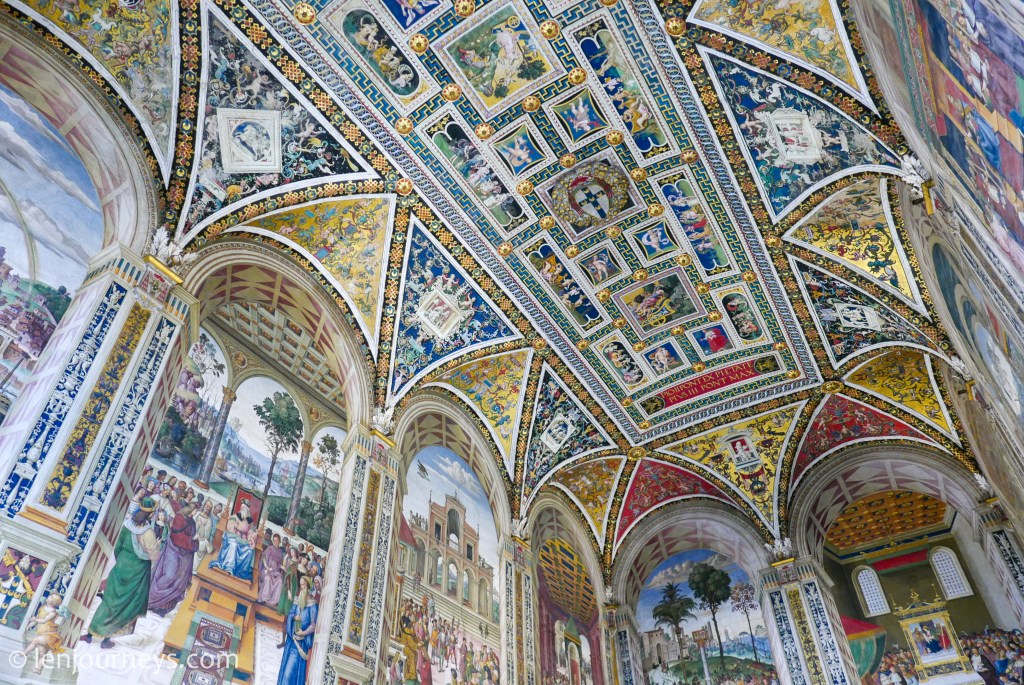
A small entry opens onto the vaulted library adorned with grotesque-styled frescoes full of bright colors and intricate gold details. They vividly portray significant moments in Pope Pius II’s life, featuring luxuriously attired figures, enchanting landscapes, and elaborate ceremonies. At the center of the library stands a marble replica of the Three Graces from the Roman era, based on an even older original dating back to the Hellenistic period. While looming large on the ceiling is the coat of arms of the Picolomini family – five crescents over a cross.



4. Santa Maria della Scala
Just across from the cathedral’s square is Santa Maria della Scala, a cultural center that originates from a 12th-century hospice dedicated to caring for orphans, the poor, and the sick. Another service offered by this hospice was to accommodate pilgrims traveling the Via Francigena – an ancient pilgrimage route running from Canterbury to Vatican City. Today, the site has transformed into a museum complex where Siena’s past unfolds through seven levels.
The museum complex has a vertical design, sloping down from the cathedral’s square to the valley below. The three uppermost floors were once the women’s hospital but are now reserved for special exhibitions and events. Meanwhile, the fourth floor, which opens to the square, is a remnant of the medieval hospice. It includes a remarkable pilgrims’ hall adorned with vivid 15th-century frescoes depicting the hospice’s missions and daily routine.
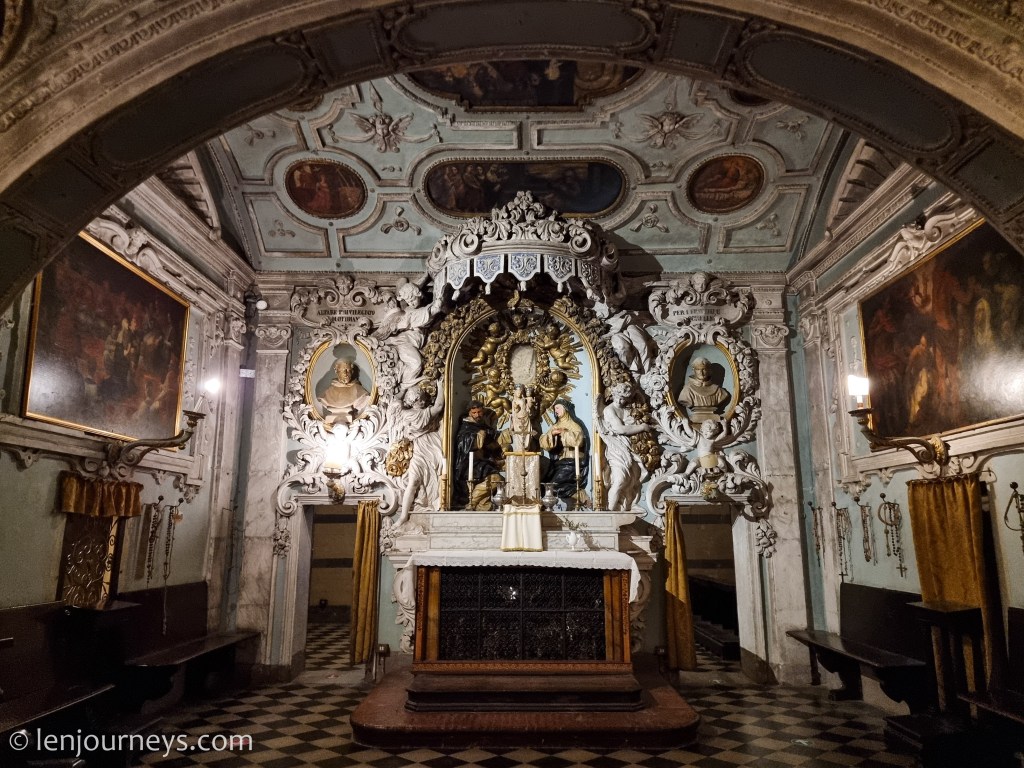
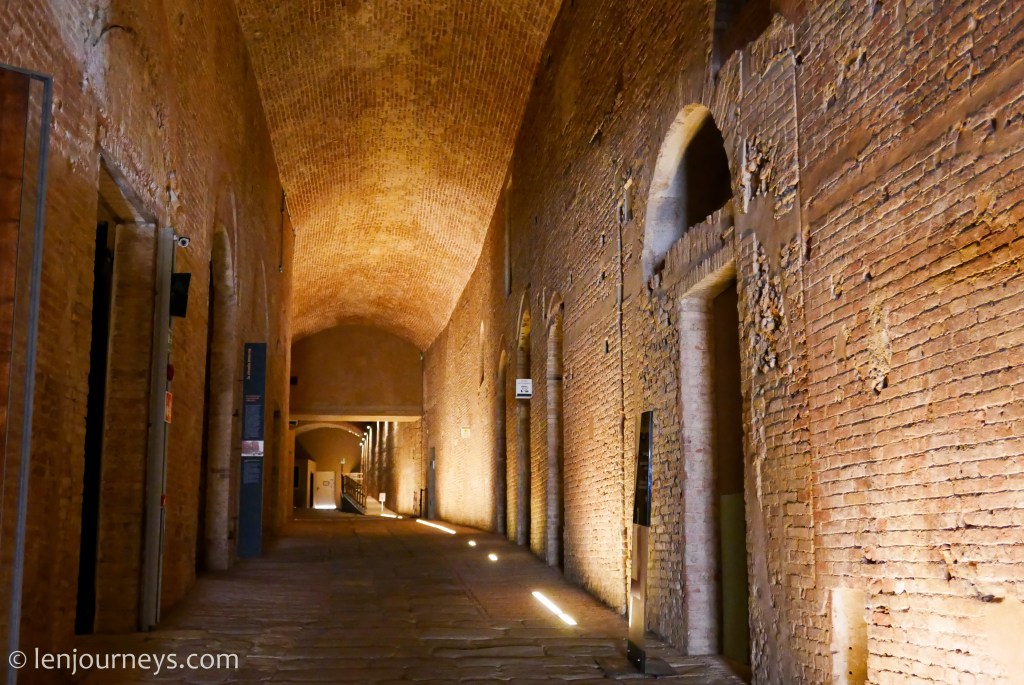
Right below it is the cistern courtyard encircled by the granary, the warehouse, and an underground chapel decorated with astonishing stuccoes and canvases. Descending further is a network of basement tunnels that makes up the Archeological Museum. These tunnels display evidence and artifacts excavated in the Sienese territory from various periods, from the Etruscan and Roman ages to the Renaissance.
A medieval hospice turns museum.


Tips for visiting Siena
- Siena is easily accessible by train from Florence, with frequent departures every hour. The journey takes approximately 90 minutes.
- A combined ticket, Opa Si Pass, grants access to all sites within the cathedral complex, including the Picolomini Library. The pass is valid for three consecutive days.
- There is a special pass called the Gate of Heaven, which allows visitors to explore the cathedral’s roof in addition to the usual sites. It’s a short guided tour that provides a unique perspective of the stunning architecture. However, this tour is not recommended for those with mobility restrictions.
- While admission to Palazzo Pubblico is free, access to its interior (now the Civic Museum) and the tower requires a ticket. It’s advisable to purchase the tickets online in advance, as they tend to sell out quickly.


It’s crazy to think of how many people died of the Black Death in Siena alone. I can’t imagine how devastated the city must have been as a result. I always love looking at photos of the cathedral in Siena, exactly because of those alternating horizontal bands, such a unique feature that makes it stand out among other structures. And it’s very interesting to learn about the history of the Torre del Mangia. At that time, building something to symbolize a balance of power between the state and the church was rather revolutionary, I guess.
It’s indeed revolutionary. Perhaps the bishop of Siena is liberal and more of a humanist (like his uncle). If he were a conservative one, the tower would be cut down 🙂
I’ve been to Italy many many times, but never made it to Siena. It looks like a perfectly preserved medieval town that should be on any Tuscany itinerary especially given that its historic center has been declared a UNESCO World Heritage Site. Thanks for sharing, and have a good day 🙂 Aiva xx
Agree. Siena should definitely have a spot on any Tuscany itinerary. Though not as popular as Florence’s, the cathedral and townscape is astounding. I’m glad that you like the post, Aiva 🙂
🥰🥰🥰